Introduction: Why the Leasing Industry Can No Longer Rely on Manual Processes
The leasing industry has always been paperwork-heavy.
Applications, approvals, background checks, contracts, renewals, payments, and maintenance requests—each step traditionally involves emails, spreadsheets, phone calls, and manual data entry. While this approach may have worked in the past, it is no longer sustainable in today’s fast-paced, technology-driven environment.
Workflow automation in the leasing industry is no longer a luxury—it is a necessity.
Automation helps leasing companies, property managers, and landlords reduce costs, eliminate errors, improve tenant experience, and scale operations without adding staff. Most importantly, it creates efficiencies that directly impact profitability and long-term growth.
This article explores how workflow automation transforms leasing operations, where the biggest efficiency gains come from, and why companies that delay adoption risk falling behind.
Understanding Workflow Automation in Leasing
Workflow automation refers to the use of software and digital tools to automate repetitive, rule-based tasks across the leasing lifecycle.
Instead of relying on manual intervention, automated systems:
- Trigger actions automatically
- Route information to the right people
- Maintain accurate records in real time
- Reduce delays and miscommunication
In the leasing industry, automation connects people, processes, and data into a seamless system.
The Traditional Leasing Workflow Problem
Before automation, leasing workflows often suffer from:
- Repetitive data entry across multiple systems
- Delays caused by human dependency
- Inconsistent communication with prospects and tenants
- Higher error rates in contracts and payments
- Limited visibility into performance metrics
These inefficiencies don’t just waste time—they increase operational risk and reduce customer satisfaction.
How Workflow Automation Creates Efficiencies
1. Faster Lead Response and Application Processing
Speed matters in leasing.
Automated workflows can:
- Instantly respond to inquiries
- Schedule property viewings automatically
- Guide prospects through digital applications
- Pre-screen applicants using predefined criteria
This reduces response time from days to minutes, increasing conversion rates and reducing vacancy periods.
2. Streamlined Tenant Screening and Approvals
Manual screening is slow and inconsistent.
Automation allows:
- Background and credit checks to run automatically
- Approval workflows to route to decision-makers
- Notifications to trigger at each stage
The result is a faster, more consistent approval process with fewer bottlenecks.
3. Automated Lease Creation and Management
Lease documents are a major source of errors.
Workflow automation:
- Generates leases from standardized templates
- Auto-fills tenant and property data
- Routes documents for e-signatures
- Stores contracts securely in one system
This eliminates repetitive drafting and reduces legal and compliance risks.
4. Improved Payment Collection and Tracking
Rent collection is critical to cash flow.
Automated systems:
- Send payment reminders
- Enable recurring payments
- Track late fees automatically
- Update accounting records in real time
This improves collection rates while reducing manual follow-ups.
5. Maintenance and Service Request Automation
Maintenance workflows are often chaotic.
Automation helps by:
- Allowing tenants to submit requests digitally
- Automatically assigning tasks to vendors
- Tracking status and completion times
- Notifying tenants of updates
This improves response time, transparency, and tenant satisfaction.
Operational Efficiency Through Data Centralization
One of the biggest efficiency gains comes from centralized data.
Automation platforms unify:
- Tenant information
- Lease documents
- Payment history
- Maintenance records
This eliminates data silos and allows teams to make faster, better-informed decisions.
Reducing Human Error and Compliance Risk
Manual workflows increase risk.
Automation reduces:
- Incorrect data entry
- Missed deadlines
- Inconsistent lease terms
- Compliance violations
By enforcing standardized processes, leasing companies maintain consistency across portfolios and jurisdictions.
Scalability Without Proportional Cost Increases
Traditional growth requires more staff.
Automation allows leasing businesses to:
- Manage more properties with the same team
- Handle higher application volume
- Expand into new markets efficiently
This scalability is one of the most powerful advantages of workflow automation.
Enhancing the Tenant Experience
Efficiency isn’t just internal—it’s customer-facing.
Tenants benefit from:
- Faster responses
- Clear communication
- Digital self-service options
- Transparent processes
A smoother experience leads to higher retention rates and stronger brand reputation.
Cost Savings Through Automation
Automation directly impacts the bottom line by:
- Reducing administrative labor
- Lowering error-related costs
- Minimizing vacancy periods
- Improving payment consistency
Over time, these savings far outweigh the initial technology investment.
Data-Driven Decision Making
Automated workflows generate valuable insights.
Leasing companies can track:
- Lead-to-lease conversion rates
- Approval timelines
- Maintenance response times
- Tenant retention trends
These insights allow leaders to continuously optimize operations.
Overcoming Common Automation Concerns
Some companies hesitate due to fears of:
- High implementation costs
- Complex training requirements
- Loss of human touch
In reality, modern automation tools are:
- User-friendly
- Scalable
- Designed to support—not replace—human decision-making
Automation handles repetitive tasks so teams can focus on relationships and strategy.
The Competitive Advantage of Automation
In a crowded leasing market, efficiency is a differentiator.
Companies that adopt workflow automation:
- Close deals faster
- Operate leaner
- Deliver better tenant experiences
- Adapt quickly to market changes
Those that don’t risk falling behind more agile competitors.
Future Trends in Leasing Workflow Automation
Looking ahead, automation will continue to evolve through:
- AI-powered tenant screening
- Predictive maintenance
- Smart contract leasing
- Deeper integration with proptech platforms
Early adopters will benefit the most.
Conclusion: Efficiency Is the New Standard in Leasing
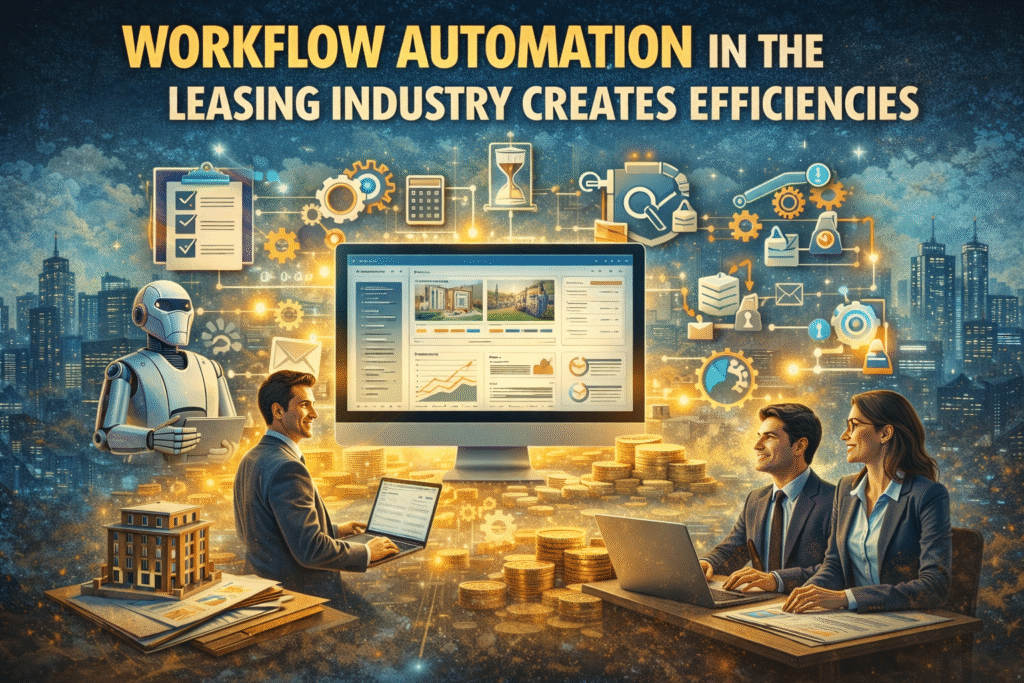
Workflow automation in the leasing industry creates efficiencies that go far beyond time savings.
It improves accuracy, scalability, customer experience, and profitability—all while reducing stress on teams.
In an industry built on processes, automation transforms operations from reactive to proactive.
The future of leasing belongs to companies that embrace smarter workflows today.
Word Count:
501
Summary:
Lease management software provider Odessa Technologies contends that automated workflow processing accelerates lease processing times, effectively manages related processes, and optimizes workforce efficiencies in any decision making environment. Any workflow process, whether it be for the decision on lease applications or vendor payments (check requests), can be accommodated by an automated workflow system that is built with adequate versatility. In fact…
Keywords:
utomated workflow system, workflow automation, workflow system, workflow software, automated workflow software
Article Body:
Lease management software provider Odessa Technologies contends that automated workflow processing accelerates lease processing times, effectively manages related processes, and optimizes workforce efficiencies in any decision making environment. Any workflow process, whether it be for the decision on lease applications or vendor payments (check requests), can be accommodated by an automated workflow system that is built with adequate versatility. In fact, the automation of decision making can fundamentally change the way an organization works, forcing it to confront its bottlenecks and find new ways to create efficiencies.
Workflow model applied traditionally
A standard workflow that can be managed through an automated workflow system is the lease application process. Typically, a lease application traverses through various departments or stages before an approval or rejection decision is made. An application may, for instance, first go to the credit department, then funding, and finally to the legal department before getting approval. Moreover, certain applications (i.e. those which exceed a certain pre-defined dollar limit) may have to make two (or more) stops in the credit department before moving forward. Workflows such as these can be easily modeled in an automated system; further, based on certain user-defined conditional logic (such as a credit limit), the application can even move through different paths within the same workflow.
Extending the workflow concept beyond the traditional
With the advent of sophisticated leasing software applications, it is now possible to automate entire workflow processes within an organization. Workflow automation in the leasing environment lends itself to a high degree of control over the typical processes followed by companies with tight security controls and access rights of users and roles. It also lends itself to planning, based on the data that is maintained by the system. At any given point, managers can, for instance, accurately assess where applications stand, which payments need approval, their stage in the approval process, and any related impact on cash-flow planning, etc. Performance can be appraised based on approval rates, the quality of applications, the number and type of credit checks made, the length of time a particular role/user took to make certain types of decisions, etc. Therefore, an automated workflow system not only allows for greater efficiency, but given its data-richness, also serves as a natural control and planning tool for the entire organization.
Workflow software functionality
Automated workflow software provides businesses with unparalleled flexibility and functionality. Users can easily perform a range of functions such as:
-Replicate real-world workflows for efficient management of front and back office processes
-Receive applications online or through any source desired
-Set up vendor programs, unique to each vendor
-Automate credit decisioning
-Apply pre-determined price matrices
-Automate decisions based on one or many variables
-Set up unlimited workflows to process decisions
-Define unique conditions and tasks for each stage in any workflow
-Comprehensively generate and manage all related documentation
-Process complex decisions that exactly represent the needs of each situation
-Manage and control the overall system with extensive levels of control




Tinggalkan Balasan